
India’s construction sector is under pressure to build faster, safer and with fewer skilled workers on site. MEP work (mechanical, electrical and plumbing) is often where schedules slip, because many trades compete for the same shafts, ceilings and plant rooms.
Modular MEP offers a practical answer. Instead of cutting, welding and assembling everything on site, key MEP assemblies are built in a controlled factory environment, tested, and then delivered ready to install. This guide explains how it works, where it fits, and what to consider before adopting it. It is a natural extension of a strong MEP design and engineering approach.
What Is Modular MEP?
Modular MEP, also called prefabricated or off-site MEP, means fabricating building services components in a workshop instead of on the construction site. These components are then transported and connected in their final position.
Common examples include pump and chiller skids, riser modules, plant-room packages, pre-assembled pipe and duct racks, electrical panel rooms, and bathroom or toilet pods with pre-fitted plumbing.
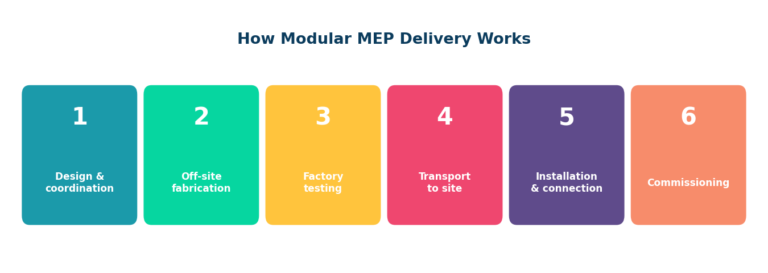
How the Process Works
Success depends on decisions made early. Prefabrication cannot be improvised on site, so the design must be frozen sooner than in conventional projects.
- Design and BIM coordination: teams model all services in 3D using Building Information Modelling to detect clashes before fabrication begins.
- Modularisation: the model is divided into transportable units sized for the lift, road and shaft constraints of the project.
- Off-site fabrication: modules are built on jigs by trained fabricators, with consistent welding, jointing and labelling.
- Factory testing: pressure tests, electrical checks and quality inspections are done before dispatch.
Delivery and installation: modules arrive in sequence, are lifted into place and connected to the main systems.
Key Benefits of Prefabricated MEP
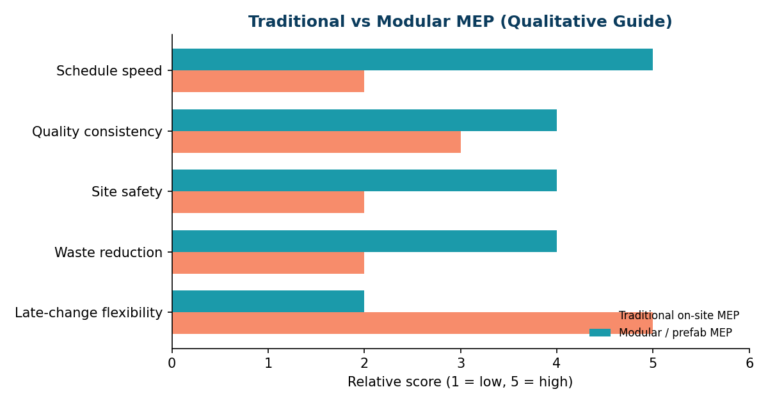
Modular delivery does not win on every measure, but it performs strongly where projects need speed, repeatability and quality control.
Where Modular MEP Works Best in India
Prefabrication delivers the strongest returns on projects with repeated layouts or tight deadlines:
- Data centres and mission-critical facilities, where speed and quality are equally important. See our guide to mission-critical MEP infrastructure.
- Hospitals, hotels and hostels with repeated rooms and bathrooms.
- IT parks, commercial offices and mixed-use towers with typical floor plates.
- Warehouses and industrial buildings that need standard plant-room and utility packages. Read more about MEP requirements for warehouses.
Challenges and How to Manage Them
Challenge | How to address it |
Early design freeze | Involve MEP consultants at concept stage and lock coordinated BIM models before fabrication |
Transport and lifting limits | Size modules for road access, gates, cranes and hoists during planning |
Tolerance and alignment | Survey the as-built structure and allow adjustable connection details |
Upfront coordination effort | Use a single accountable coordinator across trades |
Limited local fabrication capacity | Shortlist experienced fabricators and audit their quality systems |
Why Testing and Handover Still Matter
Factory testing does not replace site testing. Once modules are connected, the full system still needs verification. Understand the process in our article on MEP commissioning before handover. Guidance from industry bodies such as the Confederation of Indian Industry and the Indian Green Building Council can also help teams evaluate the sustainability benefits of off-site methods.
Frequently Asked Questions
Q – Is modular MEP more expensive than conventional MEP?
A – Upfront costs can be higher because of design effort and logistics. Savings often come from shorter schedules, reduced rework and lower site labour, so evaluate total project cost, not just material cost.
Q – Can modular MEP be used in existing buildings?
A – Yes, for retrofits and plant-room upgrades, provided modules can be brought in through available access routes.
Q – Does prefabrication reduce design flexibility?
A – Late changes are harder. That is why early coordination and design freeze are essential.
Conclusion
Commercial plumbing system design is about far more than laying pipes. Building type, water demand, materials, pressure, drainage, hot water and code compliance all interact, and each decision affects cost, comfort and long-term reliability. Getting these seven factors right at the design stage saves money, avoids disputes and gives occupants a building that simply works.
Whether you are planning a new office, hospital, hotel or industrial facility, a well-coordinated plumbing design is one of the smartest investments you can make.
Talk to our MEP experts for plumbing design that is efficient, compliant and built to last.