
Some buildings cannot afford to stop. A few minutes of downtime in a data centre can interrupt banking, e-commerce or cloud services. In a hospital, the stakes are even higher. These facilities depend on mission-critical MEP infrastructure: engineered systems designed to keep operating through failures, maintenance and emergencies.
This guide explains what makes MEP infrastructure mission-critical, the principles behind it and what owners should plan for.
What Does Mission-Critical Mean?
A facility is mission-critical when failure of its systems causes serious operational, financial or safety consequences. Typical examples include data centres, hospitals and operation theatres, pharmaceutical and research labs, telecom hubs, control rooms, and financial trading floors.
For such buildings, standard MEP design is not enough. Every system is planned for availability, resilience and maintainability.
Core Systems in Mission-Critical Facilities
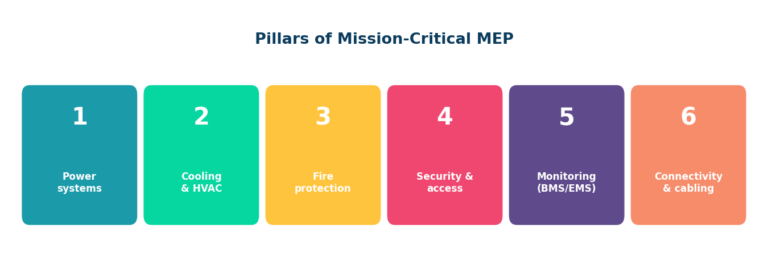
- Power: dual utility feeds, generators, UPS systems, static transfer switches and carefully designed distribution.
- Cooling: precision cooling that keeps equipment within strict temperature and humidity limits, often with redundant chillers and pumps.
- Fire protection: early detection and suppression suited to sensitive equipment, along with reliable fire pumps.
- Security and access control: layered physical protection for critical areas.
- Monitoring: BMS, EPMS and DCIM platforms that give real-time visibility and alerts.
- Connectivity: diverse, protected cabling and telecom pathways.
Redundancy: The Heart of Resilience
Redundancy means installing more capacity than the load needs, so that a failed or serviced component does not interrupt operations. The common notation is:

- N: exactly enough capacity, with no spare.
- N+1: one extra unit, so any single failure is covered.
- 2N: two fully independent systems, each able to carry the entire load.
- 2N+1: two independent systems, each with an additional spare.
Higher redundancy raises reliability but also increases cost, space and complexity, so it should match the actual business risk.
Understanding Tier Levels
Data centres are often described using the four Tier levels defined by the Uptime Institute. They describe how much redundancy and fault tolerance the site has.
Tier III facilities are concurrently maintainable, meaning equipment can be serviced without shutting the site down. Tier IV adds fault tolerance so that a single failure of any component or path does not affect operations. Availability figures above are those commonly quoted for each Tier.

Design Principles That Matter
- Eliminate single points of failure across power, cooling and controls.
- Design for concurrent maintenance so work never forces a shutdown.
- Separate critical paths physically, so one incident cannot damage both.
- Plan for growth with modular capacity that can be added without disrupting live loads.
- Keep systems simple and clear to operate, because human error is a major cause of outages.
Rising Demands from AI and High-Density Computing
Growing AI workloads are pushing rack power far beyond older designs, changing both electrical distribution and cooling. Learn how in our article on liquid cooling in data centres.
Commissioning and Ongoing Operations
Mission-critical systems must be proven before go-live. Integrated systems testing, including simulated utility failure, is a must. Our guide to MEP commissioning explains the process. After handover, preventive maintenance, spare-parts planning and trained operators keep reliability high. Policy and digital infrastructure initiatives from the Ministry of Electronics and IT continue to raise the demand for reliable facilities in India.
To speed up delivery, many owners now use prefabricated MEP modules for power and cooling plant.
Frequently Asked Questions
Q – Is mission-critical MEP only for data centres?
A – No. Hospitals, labs, telecom sites, banks and control centres also need high-availability MEP design.
Q – What is the difference between N+1 and 2N?
A – N+1 adds one spare unit to a shared system. 2N provides two complete, independent systems, offering much higher fault tolerance at higher cost.
Q – How much redundancy do I need?
A – It depends on the cost of downtime, regulatory needs and business risk. A design consultant can model options against your requirements.
Conclusion
Mission-critical MEP infrastructure protects the operations that businesses and communities depend on. Through redundancy, careful design, rigorous testing and disciplined operation, these facilities stay online when it matters most.
The right level of resilience is a business decision, and it should be made at the start of the project, not after construction begins.
Building a mission-critical facility?
Talk to our MEP specialists about resilient power, cooling and fire safety design for your project.