
When a fire breaks out, sprinklers and hydrants only work if water reaches them at the right pressure and flow. That job belongs to the fire pump room, the heart of a building’s fire fighting system.
A poorly planned pump room can flood, overheat, become inaccessible or fail to start. This guide covers the key fire pump room design considerations every commercial building should address.
What Does a Fire Pump Room Do?
The fire pump room houses pumps, controllers, valves and related equipment that supply water to sprinklers, hydrants and hose reels. It works together with fire water storage tanks and the piping network throughout the building.
A simplified layout looks like this:

Main Components
- Main pump (electric): the primary pump that supplies fire water at the required flow and pressure.
- Standby pump (often diesel): a backup that runs if power fails or the main pump does not start.
- Jockey pump: a small pump that maintains system pressure and covers minor leaks so the main pumps do not start unnecessarily.
- Controllers and panels: start and stop the pumps automatically and manually.
- Suction and discharge piping, valves and manifold: including isolation valves, non-return valves and test connections.
- Fire water tank: dedicated storage with adequate capacity and reliable filling.
How the Pumps Work Together
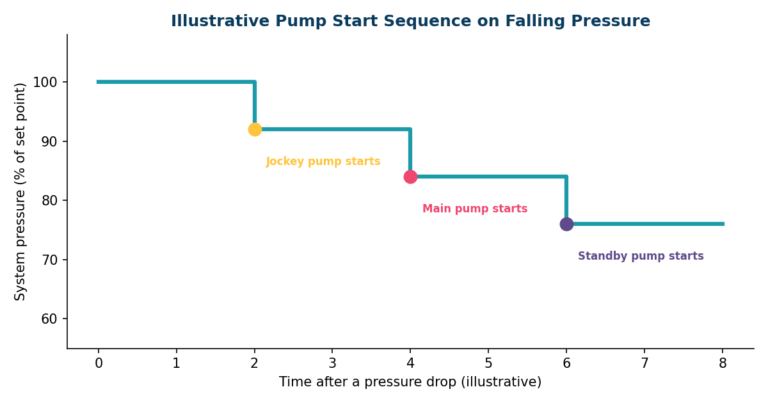
Pumps usually start in stages as pressure falls. The jockey pump handles small drops, the main pump starts on a larger drop, and the standby pump starts if pressure keeps falling. Setpoints are defined by the designer and the applicable standard, and the chart below is illustrative only.
Key Design Considerations
Location and access
Place the pump room at a location with direct, safe access from outside, preferably at ground or basement level near the fire water tank. It should be protected from fire and flooding, enclosed in fire-rated construction, and clearly marked.
Capacity and pressure
Pump flow and head are calculated from the hazard classification, hydraulic design of sprinklers and hydrants, building height and the most demanding area. Tall buildings often need pumps in stages or zones. The National Building Code, published by the Bureau of Indian Standards, and NFPA 20 on stationary fire pumps are widely used references. Always confirm requirements with local fire authorities.
Power supply
Electric pumps need a reliable, dedicated supply with protection suited to fire service. Backup is provided by a diesel pump or an emergency generator, as required. Coordinate with the building’s electrical design, as described in our guide on electrical load management.
Diesel pump requirements
Adequate fuel storage and an easy refuelling path.
Combustion air and exhaust routed safely outside.
Ventilation and cooling to prevent overheating.
Battery systems and regular test runs.
Ventilation, drainage and space
Ventilation to control heat from motors and engines.
Floor drains and sumps to handle test discharge and leaks.
Space around equipment for maintenance and replacement.
Good lighting and emergency lighting.
Clear labelling of valves, pumps and pipework.
Water storage
The fire tank must hold enough water for the required duration, be separate from domestic storage or protected from being drawn down, and allow the pumps to take suction with the correct head and no air. See how water storage differs from other uses in our overview of commercial plumbing design.
Testing, Commissioning and Maintenance
A pump that has never been tested cannot be trusted. Flow tests, start sequence tests, power-failure tests and alarm checks should all be completed before handover. Read more about the process in our article on MEP commissioning. Afterwards, run regular weekly or monthly no-flow tests and schedule periodic full-flow tests, following the maintenance guidance in the applicable codes and by the pump manufacturer.
Special Cases
Warehouses, data centres and industrial sites often need higher flows and stricter reliability. See our guides on warehouse MEP requirements and mission-critical MEP infrastructure. Pump skids built off-site can also speed up delivery, as explained in our article on modular MEP.
Common Mistakes to Avoid
- Undersized rooms with no maintenance space.
- Pump rooms in areas that flood.
- Shared power sources with no fire-rated protection.
- Poor ventilation for diesel engines.
- No isolation valves or test connections.
- Skipping regular testing after handover.
Where Growth Is Coming From
Three trends stand out. High-density computing is raising the load on data centres and IT floors; see liquid cooling in data centres and mission-critical MEP infrastructure. Automation and charging equipment are reshaping warehouses; see MEP requirements for warehouses. Electrification of heating and transport is adding to nearly every commercial building.
Test, Verify and Keep Improving
Protection settings, generator transfer and load tests should be verified during commissioning. After handover, review load data regularly, update single-line diagrams, and follow energy-efficiency guidance from the Bureau of Energy Efficiency. Also coordinate with other services such as plumbing pumps and boosters, which add motor loads.
Frequently Asked Questions
Q – Why does a fire pump room need a jockey pump?
A – It keeps the system pressurised and covers small leaks, preventing the main pumps from starting and stopping repeatedly.
Q – Is a diesel fire pump always required?
A – Not always. Requirements depend on the codes, building type and reliability of the power supply. Many projects use a diesel standby pump to ensure operation during a power failure.
Q – How often should fire pumps be tested?
A – Follow the schedule in the applicable code, the local fire authority and the manufacturer, with regular no-flow tests and periodic full-flow tests.
Conclusion
The fire pump room is a small space with a huge responsibility. Careful planning of location, capacity, power, ventilation and testing ensures the system performs when lives and property depend on it.
Involve your MEP and fire safety consultants early, so the pump room is designed right the first time.
Need a reliable fire fighting system?
Our team designs code-compliant fire pump rooms and complete fire protection systems for commercial buildings.