
Climate control used to mean a thermostat on the wall and a technician’s annual visit. That era is ending fast. Across India’s offices, hospitals, malls, and residential towers, HVAC systems are being rewired — quite literally — with sensors, AI-driven controls, and cloud dashboards that turn heating and cooling from a fixed utility into a responsive, data-driven system. The result: lower energy bills, fewer breakdowns, and buildings that actually adapt to the people inside them.
Why Smart HVAC Matters Right Now
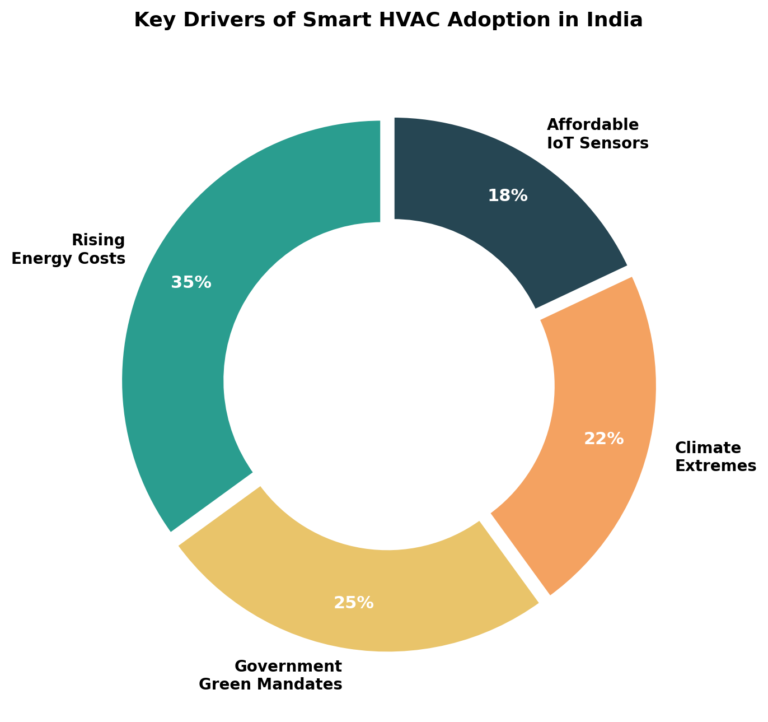
- Energy costs keep climbing. HVAC typically accounts for 40–60% of a commercial building’s total energy use in India — even small efficiency gains translate into significant savings.
- Extreme weather is the new normal. Longer, hotter summers and unpredictable monsoons push traditional systems past their design limits, while smart systems adapt output dynamically.
- Green certifications now expect it. IGBC, GRIHA, and LEED India scoring increasingly rewards measurable, automated energy performance over static equipment specs.
What Exactly Is a Smart HVAC System?
A smart HVAC system layers sensors, connected controllers, and software analytics on top of conventional heating, ventilation, and air-conditioning hardware. Instead of running on fixed schedules, it continuously reads real-world conditions — occupancy, outdoor weather, indoor air quality, time of day — and adjusts output accordingly. The physical equipment (compressors, ducts, dampers, valves) stays largely the same; what changes is how intelligently that equipment is operated.
The Technology Behind the Shift
IoT Sensors and Real-Time Data
Temperature, humidity, CO2, and occupancy sensors feed live data into the system, replacing guesswork with actual conditions on the ground.
AI-Driven Predictive Control
Machine learning models forecast demand — anticipating a hot afternoon or a full conference room — and pre-adjust output instead of reacting after the fact.
Cloud Dashboards and Remote Management
Facility teams can monitor, troubleshoot, and adjust HVAC performance across multiple sites from a single screen, often from a phone.
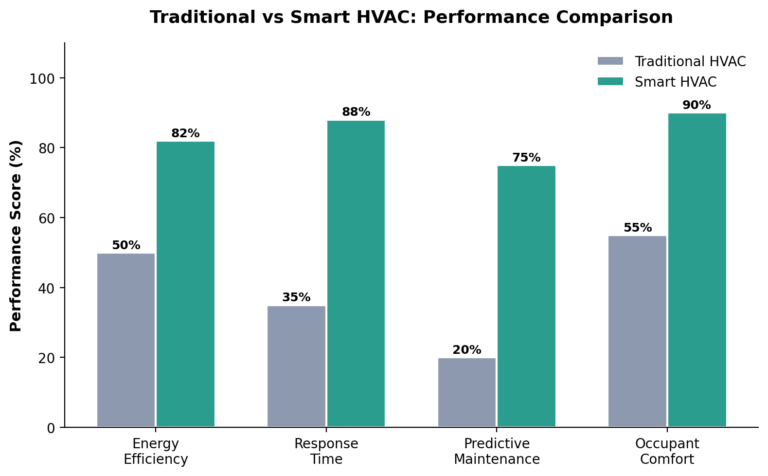
Traditional HVAC vs Smart HVAC
|
Feature |
Traditional HVAC |
Smart HVAC |
|
Control Method |
Manual thermostats / fixed timers |
App/BMS-controlled, sensor-driven |
|
Energy Use |
Runs at fixed output regardless of demand |
Adjusts output in real time to occupancy & load |
|
Maintenance |
Scheduled or reactive servicing |
Predictive alerts before failure |
|
Zoning |
Whole-building or single-zone control |
Room-by-room / zone-level control |
|
Data & Insights |
None |
Usage analytics, remote monitoring, reports |
Getting Started: Choosing and Implementing Smart HVAC
Step 1: Benchmark Current Energy Use
Establish a baseline of existing HVAC energy consumption and performance before adding automation — you can’t measure improvement without one.
Step 2: Prioritize High-Impact Zones
Start with the highest-traffic or highest-energy-use areas rather than automating the entire building at once; this proves ROI faster and reduces rollout risk.
Step 3: Integrate With a Central BMS
Connect smart HVAC controls to a unified Building Management System so heating, cooling, and ventilation data all feed into one decision-making layer.
Pitfalls Worth Avoiding
- Retrofitting without a baseline — you won’t be able to prove or track energy savings without pre-automation data.
- Over-automating too fast — rolling out across an entire facility at once makes troubleshooting harder if something misconfigures.
- Neglecting the physical hardware — worn ductwork, poorly sized dampers, or leaking valves undercut even the smartest control software.
- Skipping staff training — facility teams need to understand the new dashboards, or they’ll default back to manual overrides.
Component Quality: Where Smart HVAC Performance Actually Comes From
Software and sensors get most of the attention, but a smart HVAC system is only as good as the physical components executing its decisions. Dampers that don’t seal properly, valves with inconsistent flow control, or actuators that lag behind commands all undermine the precision the automation layer is trying to deliver. Specifying quality, automation-compatible dampers and valves at the design stage — rather than retrofitting cheaper components later — is what actually determines whether the ‘smart’ half of the system can do its job.
Frequently Asked Questions
Q – Can smart HVAC be added to an existing building, or only new construction?
– Most commercial buildings can retrofit smart controls onto existing HVAC hardware — full replacement is rarely necessary unless the equipment itself is outdated or undersized.
Q – How long does it take to see energy savings?
– Many facilities see measurable reductions within the first billing cycle after commissioning, with full savings typically stabilizing over 3–6 months as the system learns usage patterns.
Q – Does smart HVAC require constant internet connectivity?
– Most systems can run core automation locally even during connectivity drops, but remote monitoring, alerts, and cloud analytics need a stable internet connection.
Q – Is smart HVAC only worth it for large commercial buildings?
– No — while ROI is fastest in large, high-occupancy buildings, mid-sized offices and even residential complexes are increasingly adopting scaled-down smart HVAC for comfort and cost control.
Conclusion
Smart HVAC isn’t a single product — it’s a shift in how climate control is managed, from fixed schedules to real-time, data-driven decisions. As energy costs rise and green building standards tighten across India, the buildings that adapt their HVAC intelligence today will be the ones spending less, breaking down less, and staying compliant longer.
Upgrading your building’s climate control? Make sure the dampers, valves, and mechanical components behind your smart HVAC system are built to keep up with the automation layer. Contact us today to discuss your project.