
Every apartment complex, IT park, and township generating sewage above a specified limit is legally required to treat that wastewater on-site before it’s discharged or reused. A sewage treatment plant (STP) installation is no longer optional for most new developments in Mumbai and Thane — it’s a compliance requirement tied directly to occupancy approvals and environmental clearances. This guide covers what an STP installation involves, who needs one, and what the process looks like from design to commissioning.
What Is a Sewage Treatment Plant (STP)?
An STP is a system of civil and mechanical units that treats domestic wastewater — removing solids, organic matter, and pathogens — so the treated water can be safely reused for flushing, gardening, or HVAC cooling, or discharged in line with pollution control norms. For high-rise residential and commercial buildings, STPs are typically compact, modular systems designed to fit within a basement, podium, or dedicated utility area.
Who Needs an STP Installation?
As per Central Pollution Control Board (CPCB) guidelines, several categories of buildings and developments are required to install STPs based on their sewage generation:
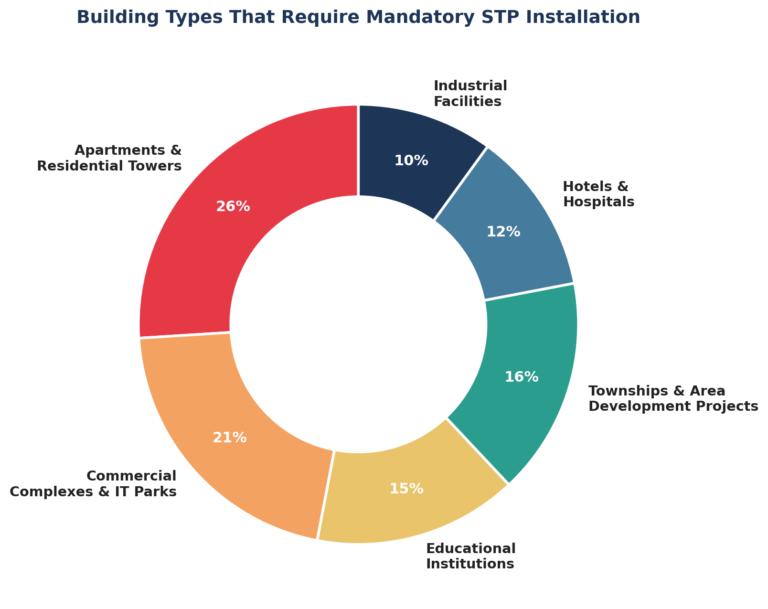
Apartments & Residential Towers
Housing societies and high-rise residential developments above specified unit counts must install an STP sized for peak occupancy sewage generation.
Commercial Complexes & IT Parks
Office buildings and IT parks with significant daily occupancy need STPs designed around working-hours sewage loads.
Educational Institutions
Schools, colleges, and campuses with hostels or large daily footfall fall under mandatory STP requirements.
Townships & Area Development Projects
Large-scale integrated townships typically require centralized STP infrastructure serving multiple buildings.
Hotels & Hospitals
High water-usage establishments need STPs designed for both volume and stricter effluent quality, given health-sensitive discharge.
Industrial Facilities
Industrial sites need STPs for domestic sewage in addition to separate effluent treatment plants (ETPs) for process wastewater.
Step-by-Step: How STP Installation Works
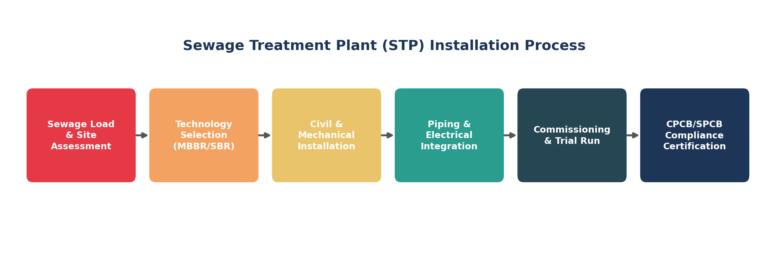
1. Sewage Load & Site Assessment
Engineers calculate daily sewage generation (in KLD — kilolitres per day) based on occupancy, and assess available space, typically in basements, podiums, or dedicated utility zones — never in the lowest basement level, per CPCB siting guidance.
2. Technology Selection (MBBR/SBR)
Depending on plot size, budget, and treated-water reuse goals, technologies such as Moving Bed Biofilm Reactor (MBBR), Sequential Batch Reactor (SBR), or Membrane Bio Reactor (MBR) are selected — MBBR and MBR are common choices for space-constrained high-rise sites.
3. Civil & Mechanical Installation
Treatment tanks, aeration chambers, and filtration units are constructed and installed, with the bar screen and oil & grease chambers positioned for easy access and maintenance.
4. Piping & Electrical Integration
Inlet and outlet piping is connected to the building’s drainage network, and blowers, pumps, and monitoring sensors are wired in as part of the broader plumbing and electrical scope.
5. Commissioning & Trial Run
The plant is run through a trial period to stabilize the biological treatment process, with BOD, COD, TSS, and pH monitored to confirm treated water meets discharge norms.
6. CPCB/SPCB Compliance Certification
Once performance is verified, documentation is submitted for compliance sign-off from the relevant State Pollution Control Board (SPCB), operating under the framework set by the Central Pollution Control Board (CPCB).
For the complete technical guidelines on STP siting, technology, and effluent standards, refer to the Central Pollution Control Board (CPCB), which sets the nationwide framework enforced locally by State Pollution Control Boards.
Common Mistakes to Avoid With STP Installation
Under-sizing the plant based on current occupancy instead of designed full occupancy
Locating the STP in the lowest basement level, against CPCB siting guidance, causing odour and flooding issues
Choosing treatment technology without considering long-term maintenance and operating costs
Delaying STP installation until late in construction, causing coordination clashes with plumbing and civil works
Skipping trial-run monitoring, leading to non-compliant effluent quality at handover
Why Choose Vaishali Enterprises for STP Installation
Since 2017, Vaishali Enterprises has delivered plumbing and PHE systems — including sewage treatment plants (STP) and effluent treatment plants (ETP) — as part of full-scope MEP contracts for residential, commercial, and industrial projects across Mumbai and Thane.
Because STP installation is planned alongside our plumbing, electrical, and drainage design from the outset, clients get a system that’s correctly sized, properly sited, and integrated cleanly with the rest of the building’s utility infrastructure — reducing rework and compliance delays at handover.
Explore our full Plumbing & PHE Systems capabilities, or see the complete range of MEP services we offer for high-rise and commercial buildings.
You can also browse our completed projects to see plumbing and MEP work delivered across Thane and Mumbai.
Conclusion
Sewage treatment plant (STP) installation is a mandatory, high-stakes part of any building’s utility infrastructure — directly tied to occupancy approvals, environmental compliance, and long-term operating cost. Getting the sizing, technology, and siting right from the start, with a contractor experienced in both the engineering and the CPCB/SPCB compliance process, saves significant rework and risk down the line.
Planning STP installation for your next project? Get in touch with our team at Vaishali Enterprises for a detailed consultation.